

From Reporting to Reasoning
Why the finance intelligence stack is built backward

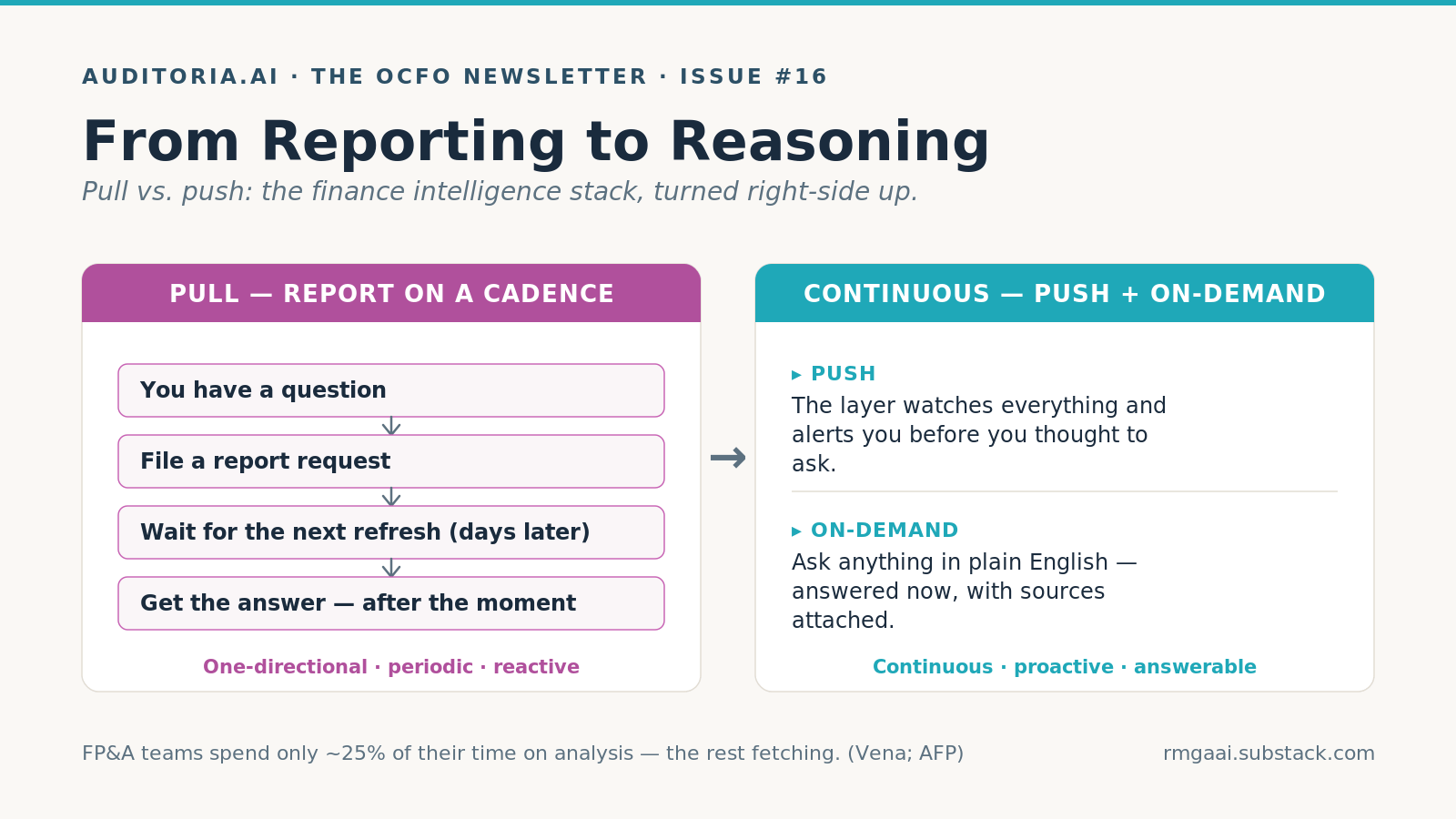
The stack was built to report, not to reason
Look at how the traditional finance intelligence stack is assembled, layer by layer.
At the bottom is the system of record — the ERP — which stores what happened. On top of that goes a transformation layer; ETL pipelines into a data warehouse which cleans and reshapes the data on a schedule. On top of that goes a visualization layer with BI tools and dashboards which renders the reshaped data into charts. And then, at the very top, sits you: expected to know your question in advance, request the report, and wait for the next refresh to answer it.
Every layer in that stack is optimized for the same thing: reporting what already happened, on a cadence. It is a magnificent machine for producing last month’s numbers on a predictable schedule. It is almost useless for answering a question you didn’t know you’d have until thirty seconds ago in a board meeting.
That’s the backward part. The architecture assumes the scarce resource is rendering ie. turning stored data into a chart. But in 2026 the scarce resource isn’t rendering. It’s reasoning meaning specifically connecting what’s happening across systems, in the moment, and knowing what to do about it. We built the whole stack to optimize the thing that stopped being the bottleneck years ago.
The inversion: from pull to push, plus on-demand
Continuous cash intelligence flips the stack over.
Instead of waiting for you to request a report, the intelligence layer monitors the underlying data continuously and pushes what matters to you surfacing an anomaly before you thought to look for it. And instead of forcing you to formulate your question in advance and wait for a refresh, it lets you ask anything, in natural language, and answers on demand with the reasoning shown and the source lineage attached, so a controller can verify the work.
This is the architecture SmartResearch was built around, and it’s worth being specific about why it can reason rather than just report. It isn’t a single model. It’s a composite: rules-based logic to enforce compliance boundaries, machine learning to detect patterns and anomalies, and language models to reason across the results and answer in plain English with every answer citing its sources. Critically, it reads across AP, AR, and the ERP at the same time, which is the only way to answer a question that spans both legs of the cash cycle. The point isn’t the model count. It’s that the layer is continuous and answerable, where the old stack was periodic and one-directional.
Here’s what that inversion looks like in three places every finance team will recognize.
Three contrasts
The weekly cash position. The pull model: someone assembles a cash report on Monday from data that was current on Friday, and the team reviews it. The continuous model: the cash position is live, and the system proactively alerts you when a threshold is crossed — a large receivable slips, an obligation clears early — the moment it happens, not at the next report. SmartResearch watches the position instead of photographing it once a week.
The month-end exception review. The pull model: exceptions pile up in a queue and get reviewed at close, days after they occurred, when the moment to act has passed. The continuous model: exceptions surface in real time, throughout the cycle, as they arise so they’re handled while they still matter. The difference isn’t speed of review. It’s whether the review happens in time to change the outcome.
The customer that’s starting to slip. The pull model: DSO is calculated per customer, by hand, after the fact you learn a top-20 account stretched its terms when the aging report runs. The continuous model: the intelligence layer is watching payment behavior continuously and flags the shift the week it starts, with the context attached, while you can still pick up the phone. Anomaly detection, not archaeology.
Notice the pattern. In every case the pull model answers the question eventually, after someone does the work. The continuous model answers it in time to act and often before you asked.
The catch: reasoning you can verify
There’s a real objection here, and finance leaders are right to raise it. A periodic report has one great virtue: you can trace every number back to its source. If you replace slow-but-trusted reporting with fast reasoning, and the reasoning is a black box, you haven’t fixed the architecture; you’ve made it worse. Speed without auditability is a liability in finance, not an asset.
That’s exactly why the continuous layer has to show its work. Every answer SmartResearch returns carries its source lineage — which records it drew from, which rule or model produced the result, with what confidence. The controller can verify the reasoning the same way they’d verify a report, only faster. Continuous intelligence earns the right to be trusted not by being quick, but by being quick andcheckable. Governed autonomy is the difference between an answer you can act on and an answer you have to go re-verify by hand which would put you right back in the “let me get back to you” loop you were trying to escape.
Why this is structural, not a nicety
It would be easy to file all of this under “nice to have faster reporting.” That undersells it. For the thing I’ve been writing about all summer; a continuous intelligence layer isn’t a convenience. It’s a precondition.
You cannot have real visibility into a cycle you can only see at month-end. You cannot exercise control over outcomes you learn about after they’ve hit cash. Visibility and control — two of the four questions of cash-cycle ownership — are only possible if the intelligence layer is continuous rather than periodic. Rebuild the stack the right way up, and ownership becomes achievable. Leave it backward, and no amount of dashboard polish will get you there.
The shift from reporting to reasoning is not a new tool bolted onto the old stack. It’s turning the stack over so the finance team you hired to reason can finally spend its time reasoning.
One question for you
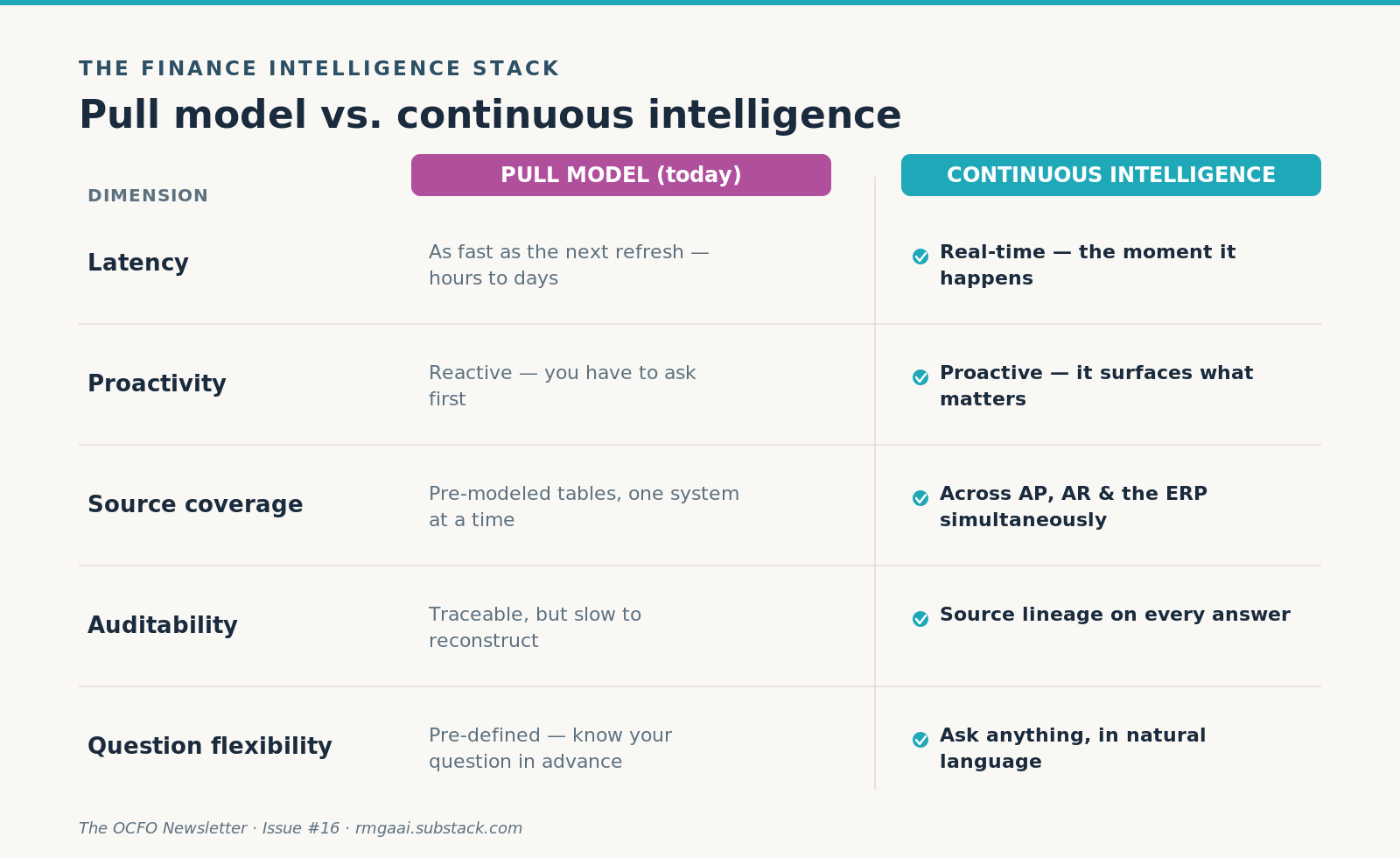
I put together a one-page comparison on the pull model versus continuous intelligence, across five dimensions: latency, proactivity, source coverage, auditability, and question flexibility. It’s attached to this issue.
And I’m genuinely curious: what is the one finance question you wish you could answer in real time….the one that always turns into “let me get back to you”? Reply and tell me. I’ll show you how SmartResearch approaches it.