

How Agentic AR changes the Collections equation
Cash Applied, Disputes Resolved and Agents driving Autonomy with Scale

Ask anyone who runs accounts receivable at a high-volume business to describe their morning, and you’ll hear a version of the same story. A remittance file lands with three hundred line items: partial amounts, missing invoice references, two currencies, a customer who paid four invoices with one wire and told no one which four. Someone on the team spends the first three hours of the day matching it to open receivables by hand. While that’s happening, forty collection follow-ups need to go out, templated, sent one at a time, tracked in a spreadsheet that only one person really understands. By noon, the AR team has spent half its day on work that required, by my count, zero judgment.
That’s the collections equation. And I want to be precise about why it matters, because it’s easy to file this under “productivity” and move on. It isn’t a productivity problem. It’s a working-capital problem wearing a productivity problem’s clothes.
The trapped cash is on the AR side
For most of the last decade, the automation money in finance went to accounts payable. There was a clean logic to it. AP has a clear document, a clear system, and a clear outcome, so AP got the invoice capture, the touchless processing, the straight-through posting. And it worked. Payables performance keeps improving.
The receivables side did not get the same investment, and the numbers show it. In the Hackett Group’s 2025 Working Capital Survey, days sales outstanding degraded for the second consecutive year even as payables improved. Hackett puts the receivables optimization opportunity across the largest U.S. public companies at roughly $600 billion. And here’s the number I’d underline if you’re thinking about where value actually gets created: there’s an 18-day DSO gap between top-quartile and median performers. Eighteen days of sales, sitting in receivables, separating the companies that collect well from the companies that collect averagely.
That gap is not a technology gap. Top-quartile collectors don’t have a better spreadsheet. What they have is coverage: every account worked, on policy, every day. The median performer can’t match it, because coverage at that scale becomes a headcount problem the moment you do it manually. You cannot hire your way to eighteen days. That’s the opening agentic AR walks through.
Three capabilities that actually move DSO
There are exactly three processes that consume the most AR time per dollar collected, and they’re the same three that move the needle: remittance automation, dunning intelligence, and dispute triage. None of them is flashy. All three are where the day goes.
Remittance automation, or cash applied without keying. Consider a services business receiving payments as PDFs, email bodies, portal exports, and SWIFT messages, none of which agree on format. An agent reads the remittance data, matches it to open invoices across formats, currencies, and partial payments, and posts the cash, reserving for a human only the genuine exceptions with the candidate matches already attached. Or picture a distributor whose largest customer nets a dozen invoices against two credit memos in a single payment. The work that used to eat a morning becomes a quick review of what the system already reasoned through. Cash applied in hours instead of days is not a convenience. It’s DSO you get back.
Dunning intelligence, or every account worked, every day. This is the capability I can show you with a real name on it.
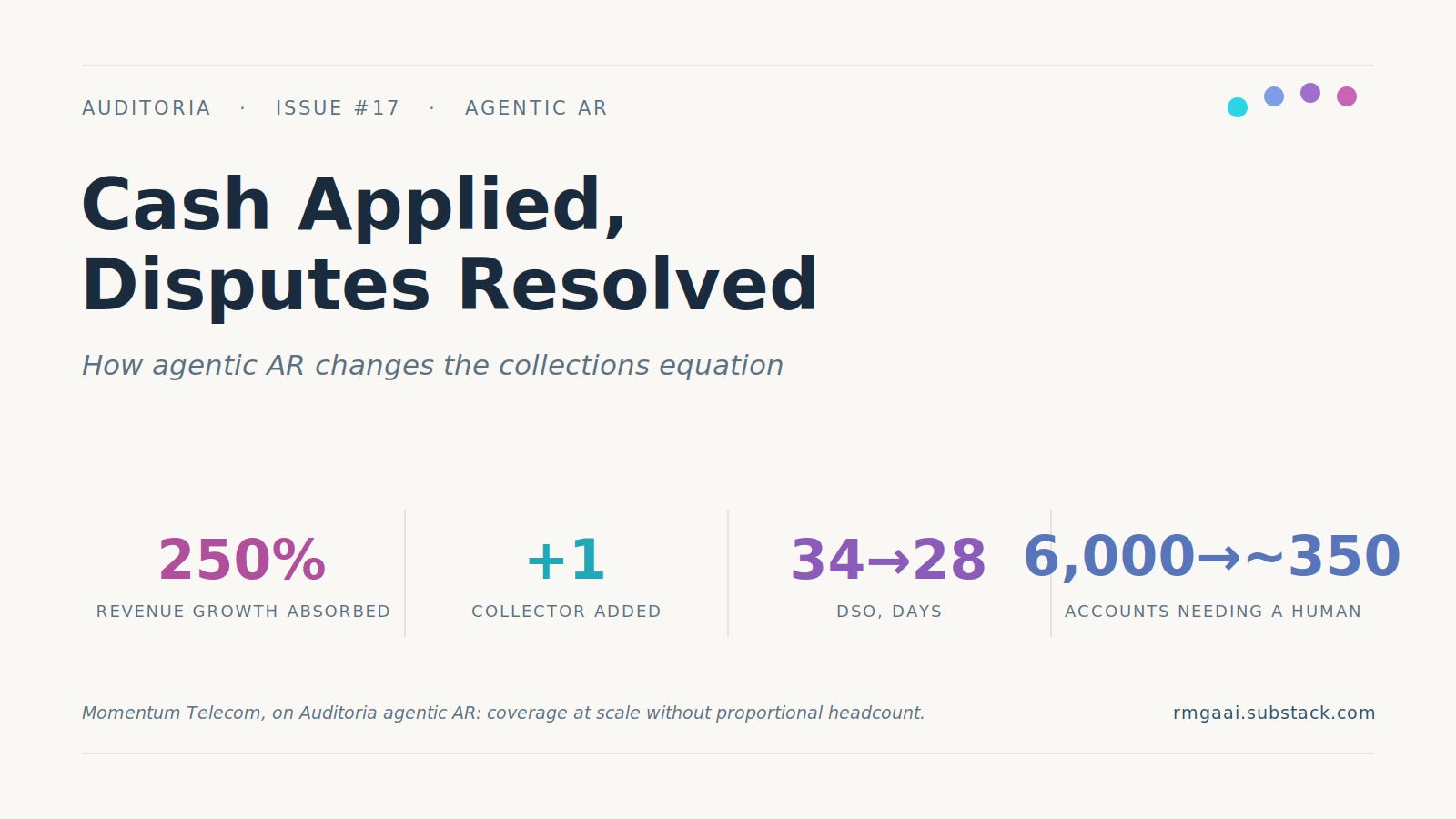
Momentum Telecom grew revenue 250% and roughly doubled its customer base, from about 3,000 accounts to more than 6,000, through organic growth and acquisition, across multiple legacy billing systems. Collections complexity compounded with every deal. And they absorbed all of it while adding a single person to the collections team.
Here’s how. Auditoria’s AR agents ingest the receivables data through a universal connector to their Logisense billing platform, run dunning strategies configured by customer segment, rank open accounts by payment behavior, and send policy-bound follow-ups without anyone scheduling them. Manual dunning effort dropped from about 75% of the team’s time to roughly 25%. The number of accounts requiring human attention fell from 6,000 to somewhere between 300 and 400. The agents clear the routine, and the team works the exceptions. DSO moved from the 30-to-34-day range down to about 28 days.
Taylor Clark, Momentum’s SVP and Controller, put the mechanism better than I can: “By growing so fast, we have only added very few people to the group, and that’s where Auditoria has really come in to help us.” His colleague Marc Palmese, who manages revenue and collections, said the thing I think about most: “Auditoria has really been our seventh team member.” Not a tool the team used. A member of the team.
Dispute triage, or the shared inbox, retired. Disputes are where collections quietly stall. An agent classifies each inbound dispute by category (pricing, quantity, duplicate, freight, tax), routes the standard categories to resolution, and escalates only the genuinely non-standard cases with the full document history attached. A distributor drowning in freight and short-ship disputes clears the routine ones automatically. A software business sees duplicate-charge and quantity disputes resolved before they age into a collections problem. The disputed invoice is the one that doesn’t get paid, so resolving it faster is, again, DSO.
What Momentum actually demonstrates
Read the Momentum numbers again, but this time the way an investor would. Revenue up 250%. Headcount up by one. That is operating leverage in its purest form: the business scaled, the cost to run collections did not. And DSO compressing several days is cash pulled off the balance sheet and back into the business, with no capital spent to get it.
That combination is rare enough to sit with for a second. Most improvements move one statement. AR automation moves two at once. It bends the cost-to-collect curve down on the P&L and it releases working capital on the balance sheet, without capex. If you operate a portfolio of companies, that’s not an IT line item. It’s a value-creation lever that happens to be denominated in software.
The math is simple enough to run on the back of an envelope, which is why I’m making it the tool for this issue. Take annual revenue, divide by 365 for revenue per day, and multiply by the number of DSO days you’d recover. A company doing $200M a year that closes even half of that 18-day gap frees roughly $5M in cash, permanently, not once. A $1B business closing the same nine days frees about $25M. The inputs are your current DSO, your open-receivables volume, and your current remittance match rate. The output is cash you already earned and haven’t collected yet.
Autonomy that survives scrutiny
Whenever I describe agents sending customer communications and posting cash, the sharpest people in the room ask the right question: what keeps it inside the lines? In finance, speed without control is a liability, not a feature.
Momentum is the cleanest answer I have. Telecom is heavily regulated, and there are state-level restrictions on how AI can access customer data. So the deployment was built to respect exactly that. Sensitive invoice requests are routed to a compliant self-service path rather than handled by an agent, dunning runs under the policy the team set, and every action is logged and attributable. The autonomy is real, and it is governed. That’s the distinction I keep returning to. Governed Autonomy isn’t autonomy with the ambition dialed down. It’s autonomy that a regulated business, or the people conducting diligence on one, can actually stand behind, because the guardrails, the audit trail, and the human-in-command controls are part of the design rather than bolted on after.
That is also what separates a system of record from a system of action. Your billing platform stores what’s owed. It doesn’t collect it. The agents decide, act, and close the loop, under policy, in real time, watching payment behavior continuously rather than photographing it once a month at close.
Own the loop, not the leg
I’ve spent much of this year arguing that finance’s real prize isn’t a better AP shop or a better AR shop. It’s owning the cash conversion cycle end to end, as one number. And the reason that prize is still sitting there unclaimed is worth saying plainly: a cash cycle is a loop, not a line.
It runs from the commitments you make (the POs, contracts, and terms), to the obligations they become (invoices and bills), to the transactions that settle them (payments and receipts), to the interactions around all of it (the emails, disputes, and status chases that never touch the ledger). Money Out is one leg. Money In is the other. Automate just one and you don’t own the cycle, you relocate the bottleneck: a faster front half bolted to the same slow back half, with a DSO that hasn’t moved. That’s why this issue is about AR, but the point was never just AR.
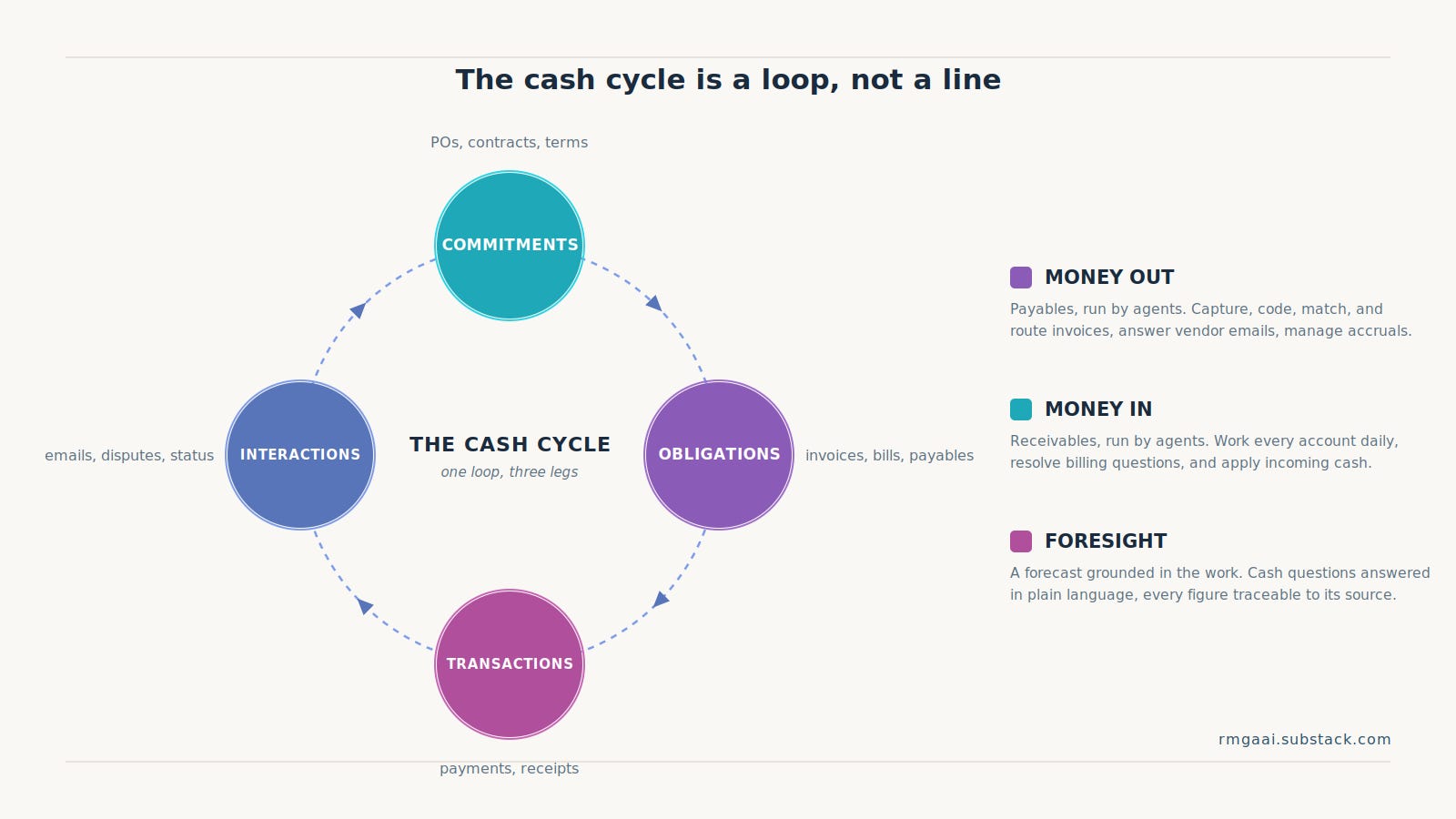
The cash cycle is a loop, not a line: Money Out and Money In as two legs, with a Foresight layer that reads both at once.
The shift that matters is that the same agents can now run both legs on one live model of the whole cycle, with a third capability sitting on top of them. Call it Foresight: a layer that reads Money Out and Money In at the same time and answers cash questions in plain language, every figure traceable to its source. Payables run by agents, receivables run by agents, and a forecast grounded in the actual work rather than a spreadsheet assembled after the fact. Systems of action, not systems of record.
Here’s the argument I’ll be making in New York this week. This is a category worth north of $70 billion, and no single vendor owns it, because software has always owned one leg and stopped at its edge. Meanwhile roughly $1.7 trillion in working capital sits trapped across the largest U.S. companies, much of it in the seams between the legs that nobody is responsible for. Owning the whole loop, end to end, under the policy you set, is the biggest unclaimed prize in finance software.
The eighteen days are sitting there. The only question is whether you go get them.
The tool this week
I put together a DSO impact calculator: three inputs (your current DSO, your open-receivables volume, and your current remittance match rate) and a projected cash-release figure from closing the gap with agentic AR. It’s attached to this issue. Run your own numbers before you take anyone’s word for the size of the prize.
And if you’re running AR on manual remittance matching and template-driven dunning today, book thirty minutes with my team at hello@auditoria.ai. Not a pitch deck. We’ll show you what your exact process looks like with agentic AR, against your stack.