

SmartResearch: The Intelligence Layer the Cash Cycle Has Been Missing
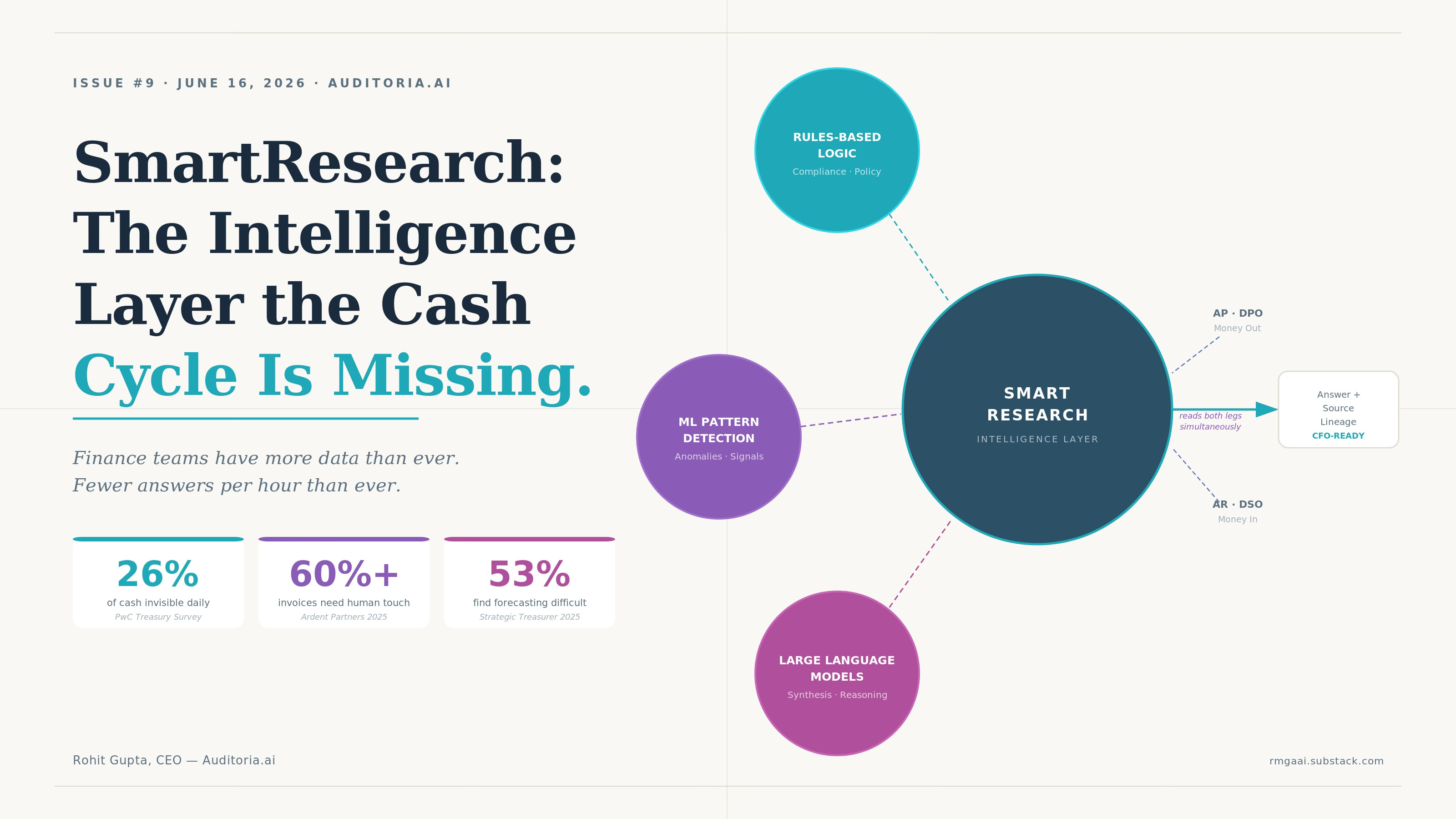
Finance teams have more data than ever. They have fewer answers per hour than ever. The problem isn't the data; it's the gap between transaction visibility and cash cycle intelligence.

There’s a question I’ve been asked in nearly every CFO conversation I’ve had over the past two years. It doesn’t come up in formal demos or structured meetings. It comes up when the conversation gets honest.
The question is: ”Why do I have more data than ever and still can’t tell my board where our cash is going to be in 30 days?”
The answer is not that CFOs lack data. Every finance team I speak to is drowning in it — ERPs, bank feeds, invoice queues, AR aging reports, FP&A spreadsheets, variance analyses. The ERP is, in fact, an extraordinary system of record. It tells you exactly what happened, when it was posted, in which account. That’s not the problem.
The problem is the gap between knowing what happened and knowing what to do about it. Transaction visibility is not cash cycle intelligence. And the tools finance teams have been using to bridge that gap namely, dashboards, scheduled reports, BI layers and more, were designed for a different era.
The gap is three layers deep
The visibility problem shows up first. According to PwC’s Global Treasury Benchmarking Survey, 26% of global cash is invisible to treasury on any given day. The authoritative picture of where the cash is doesn’t arrive until close — six-plus business days after month-end. Decisions get made in the intervening time on estimates and instinct.
The processing problem compounds it. Ardent Partners’ 2025 AP Metrics report found that more than 60% of invoices still require human touches across the industry. Exception rates average 22.6% for teams on template-based capture; meaning roughly one in five invoices kicks out to manual review. Every invoice in that exception queue is a commitment that’s delayed, a payable that isn’t fully visible, a gap in the Money Out picture.
The forecasting problem ties it together. Strategic Treasurer’s 2025 Cash Forecasting & Visibility Survey found that 53% of organizations describe forecasting as difficult or extremely difficult — up from 39% in 2018. Meanwhile, 76% of practitioners now expect AI to help close that gap. Expectations from boards and CEOs have gone up; the actual process has gotten harder. The data exists. The synthesis doesn’t.
Why no single AI model solves this
When I started building Auditoria, the simplest version of the argument was: put AI on the data. The harder version — the one we’ve actually built — is that different finance problems require fundamentally different kinds of reasoning, and no single AI model is sufficient for all of them.
Rules-based logic handles compliance boundaries with certainty. It’s deterministic, auditable, and exactly right for decisions that require zero ambiguity — payment policy enforcement, GL coding rules, approval thresholds. But rules alone produce rigid systems that break on edge cases and can’t surface patterns that no one thought to write a rule for.
Machine learning models are designed for patterns; anomaly detection, payment behavior prediction, supplier risk scoring. They surface signals that no rule would catch. But ML outputs without a reasoning layer produce noise that finance teams don’t trust and can’t explain to an auditor.
Large language models bring natural language synthesis and causal reasoning ie. the ability to ask a question in plain English and receive a structured, contextual answer. But LLMs without rules and pattern detection produce outputs that are fluent and wrong in ways that are hard to catch until after the decision has been made.
SmartResearch is a coordinated architecture of all three. Rules govern the boundaries. ML identifies the patterns. LLMs synthesize the answer. And critically, every answer cites its work.
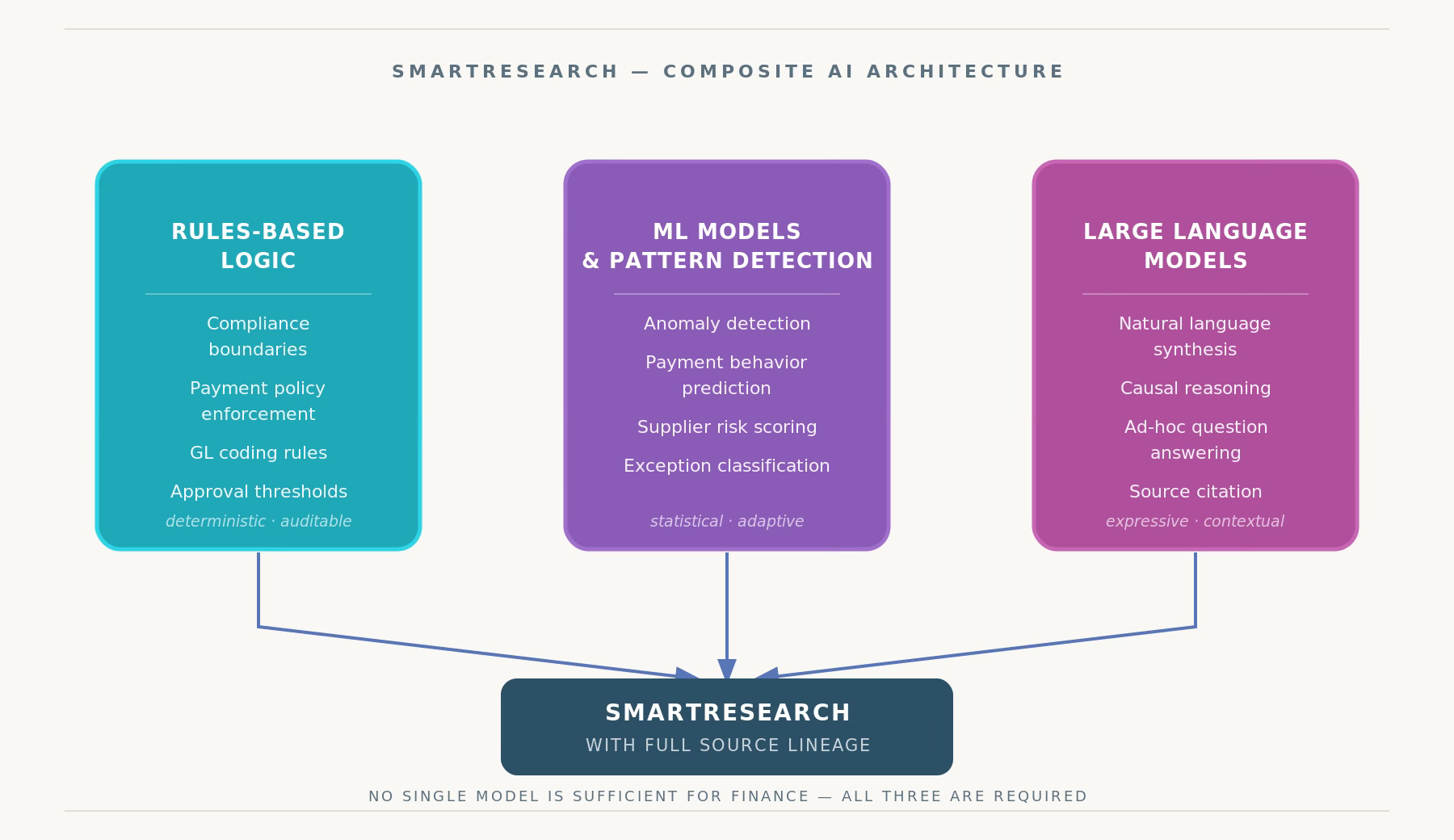
The source lineage is visible: what data was queried, from which system, by which model, with what confidence. A CFO can ask a question and trace the answer back to the invoice, the contract, the ERP line item that generated it. This isn’t a feature. It’s the architectural commitment that makes AI usable in finance.
The cash cycle differentiator
Most finance AI tools see one leg of the cash cycle. An AP analytics tool sees the Money Out picture — invoice status, exception rates, payment timing, DPO. An AR analytics tool sees the Money In picture — aging, collections progress, dispute volume, DSO. A dashboard for each, built by different teams, reviewed in different meetings.
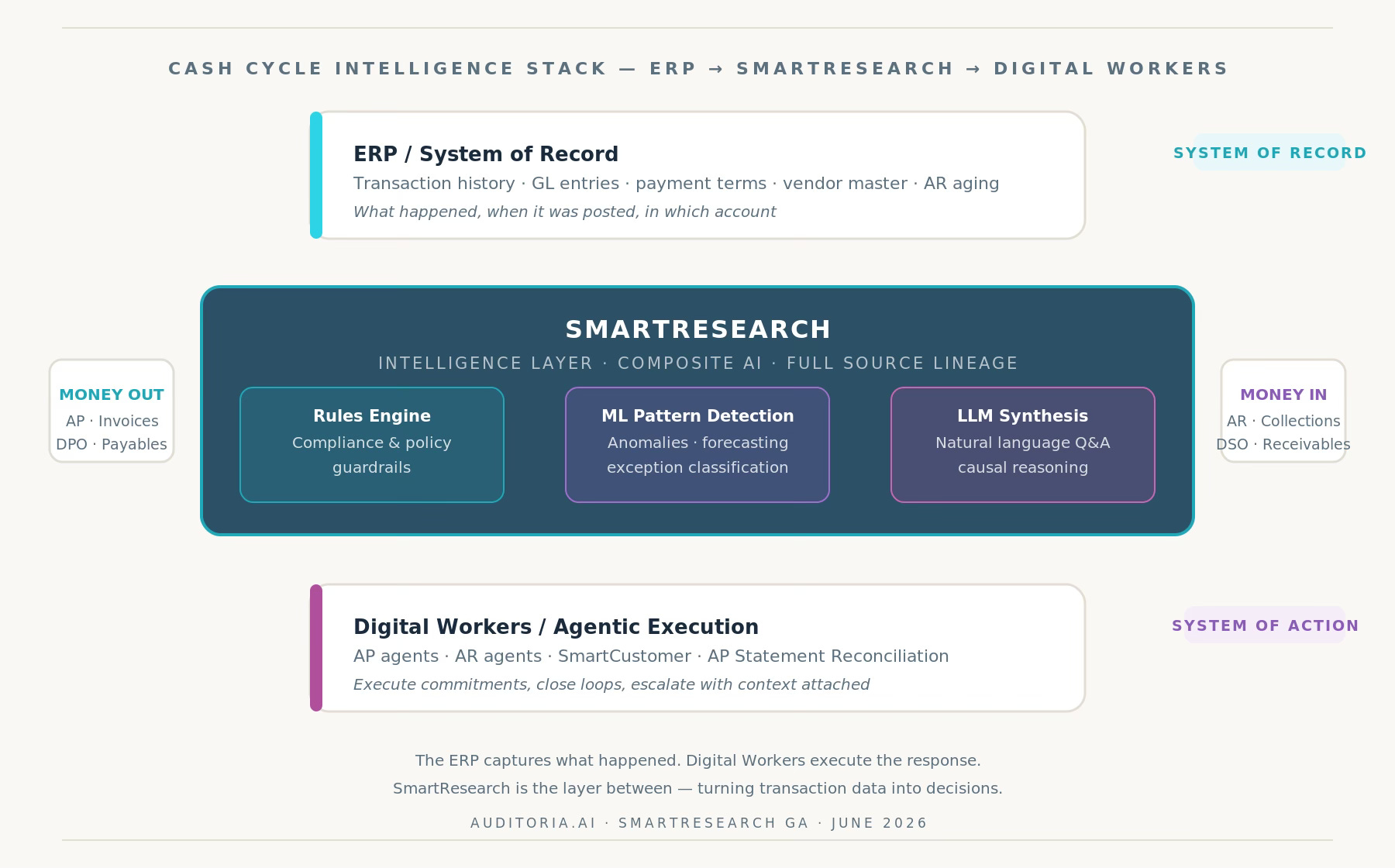
SmartResearch reads both simultaneously. It ingests the AP layer and the AR layer, alongside ERP data, to answer questions that span the full cycle. That cross-leg view is where the real cash cycle intelligence lives because cash position isn’t determined by AP in isolation or AR in isolation. It’s determined by the spread between them, and the timing on both sides.
Three questions finance can’t currently answer fast enough
Here’s what that looks like in practice.
”Which suppliers are driving the most AP exceptions this month?” Today, answering this question means an analyst pulling exception queue data, filtering by supplier, cross-referencing against historical rates, and building a summary. That’s a half-day project if the data is clean. SmartResearch answers it in under 30 seconds — ML pattern detection across invoice history, LLM synthesis, ERP data retrieval — with source lineage attached so the controller can verify every number.
”What is our projected cash position at day 45 if the three largest pending invoices clear as expected?” This question requires someone who can hold the AP picture (what’s owed, when it’s scheduled) and the AR picture (what’s expected in, based on current collections behavior) simultaneously, then synthesize a number. Without an intelligence layer, this is a spreadsheet exercise that takes hours and produces a result that’s already stale the moment it’s done. SmartResearch produces it on demand; rules-based threshold logic against payment schedules, ML forecasting on historical payment behavior, natural language output the CFO can drop into a board update.
”Why did our AP cycle time increase 18% last quarter?” This is the question finance teams almost never get to answer well, because the diagnosis requires causal reasoning across the full invoice lifecycle. Anomaly detection finds the signal. Source lineage makes the answer auditable. The output isn’t a data dump — it’s a structured causal explanation that tells the controller exactly which part of the process changed and why.
In each case, the answer isn’t generated. It’s read from the data and reasoned over. That’s the design principle: numbers read from the document, never invented.
What execution alone can’t answer
One of the patterns I’ve observed with our AP automation customers — including Boddie-Noell, where we’ve deployed agentic AP — is that the question CFOs ask after execution speeds up isn’t about processing throughput. The exception rate drops. Touchless rates improve. Invoices that used to sit in queues for days clear in hours. That’s a real operational win.
But the CFO’s question evolves. It shifts from ”can we process faster?” to ”what does all of this tell me about where our cash is going?” Agentic AP is the action layer — it executes commitments at scale. SmartResearch is the intelligence layer — it reasons across what the action layer is doing, what’s happening on the collections side, what the ERP reflects, and synthesizes it into answers.
The action layer and the intelligence layer together are what cash cycle ownership actually looks like. One without the other is faster processing with the same blind spots.
Source lineage is not a feature — it’s the governance model
The reason finance leaders are willing to trust an AI-synthesized answer in a board meeting is the same reason they trust a well-sourced analyst deck: they can trace every number back to its origin.
SmartResearch doesn’t generate answers from inference. It reads from the data and reasons over it. When the system surfaces an exception pattern, the controller can see which invoices drove it. When the forecast updates, the CFO can see which payment behavior assumptions changed. When an answer lands in a board presentation, the CFO didn’t take it on faith — they verified it, the same way they’d verify any analysis handed to them.
This is what we call Governed Autonomy at the intelligence layer. The AI earns the right to answer autonomously by making its reasoning fully visible — not as a compliance checkbox, but as the architectural commitment that makes real-time intelligence usable in a finance control environment.
The ERP gave us systems of record. AP and AR automation gave us systems of action. The intelligence layer closes the loop turning what the action layer knows into answers that drive decisions, in real time, with full auditability.
That’s the cash cycle intelligence gap. SmartResearch is how we close it.
SmartResearch is generally available. If you want to ask it a real question against a real enterprise data environment; book 30 minutes. I'll run it with you.
Sources: PwC Global Treasury Benchmarking Survey; Ardent Partners AP Metrics That Matter 2025; Strategic Treasurer Cash Forecasting & Visibility Survey 2025.