

The Cash Conversion Cycle Nobody Owns
And why that’s the CFO’s biggest problem

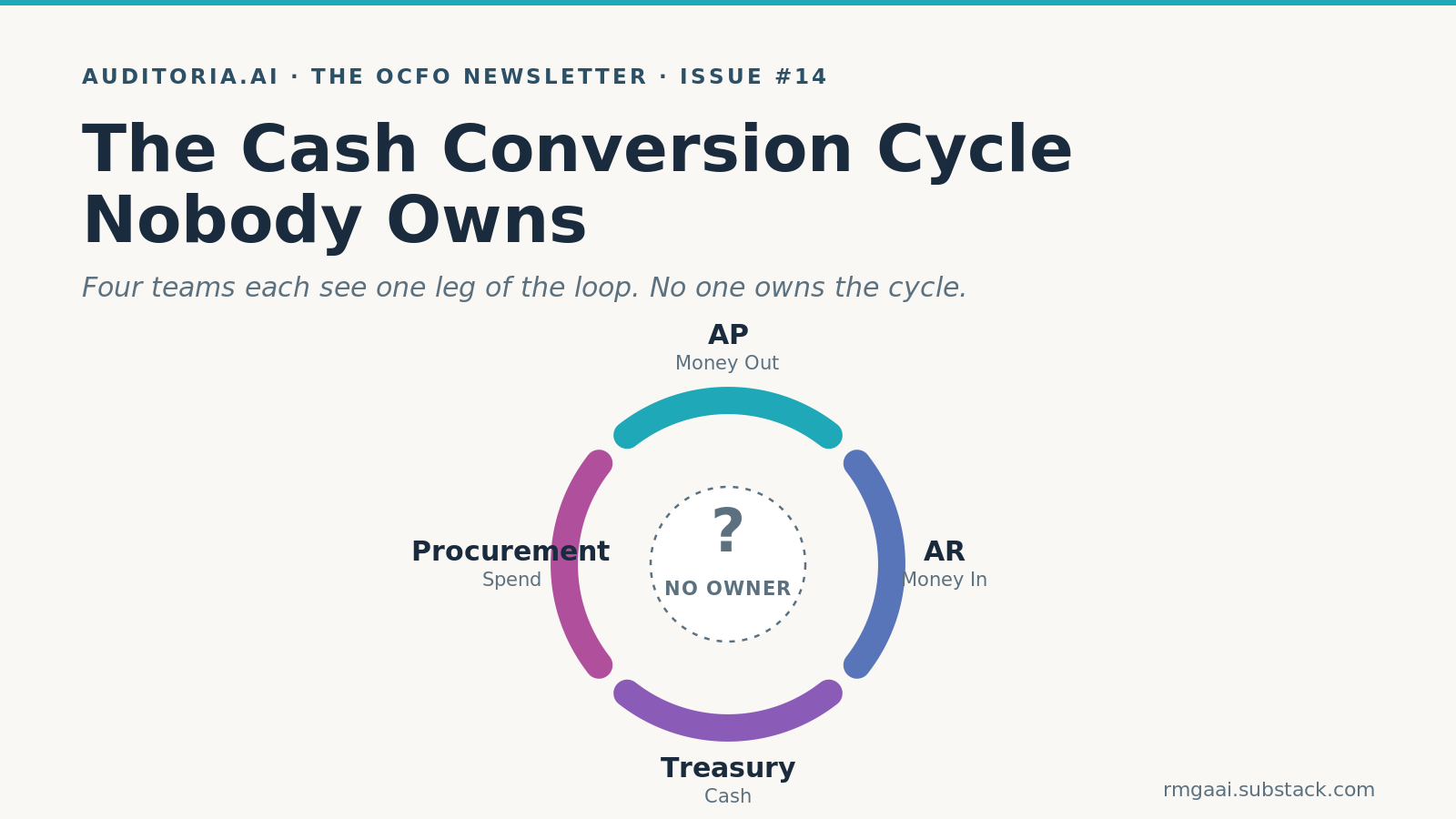
Last week I made the point that the industry has spent the first half of 2026 making the pieces of finance smarter — the close, reconciliation, disclosure, collections, payments — while the thing that runs through all of them has no owner at all. I promised I’d come back to it. This is that piece.
The cash conversion cycle runs every business. Nobody runs it.
Think about how it actually moves. Accounts Payable sees the money going out. Accounts Receivable sees the money coming in. Treasury sees the balance. FP&A sees the forecast. Each function is looking at one leg of the same loop, and the loop itself advances the way it always has; one email, one dispute, one approval, one status check at a time. By the time anyone can see what actually happened to cash, it’s month-end, and the moment to do something about it has passed.
Picture the small failures that never show up in a board deck. A 2% early-payment discount lapses because the invoice sat in an approval queue three days too long. A large customer quietly stretches from 30 days to 45, and nobody notices until the aging report runs. A supplier dispute festers in an inbox for two weeks while the same supplier holds a shipment. Each of these is somebody’s job — and none of them is anybody’s cycle. Individually they’re rounding errors. Added up, across every function, every month, they are the difference between a business that funds its own growth and one that borrows to.
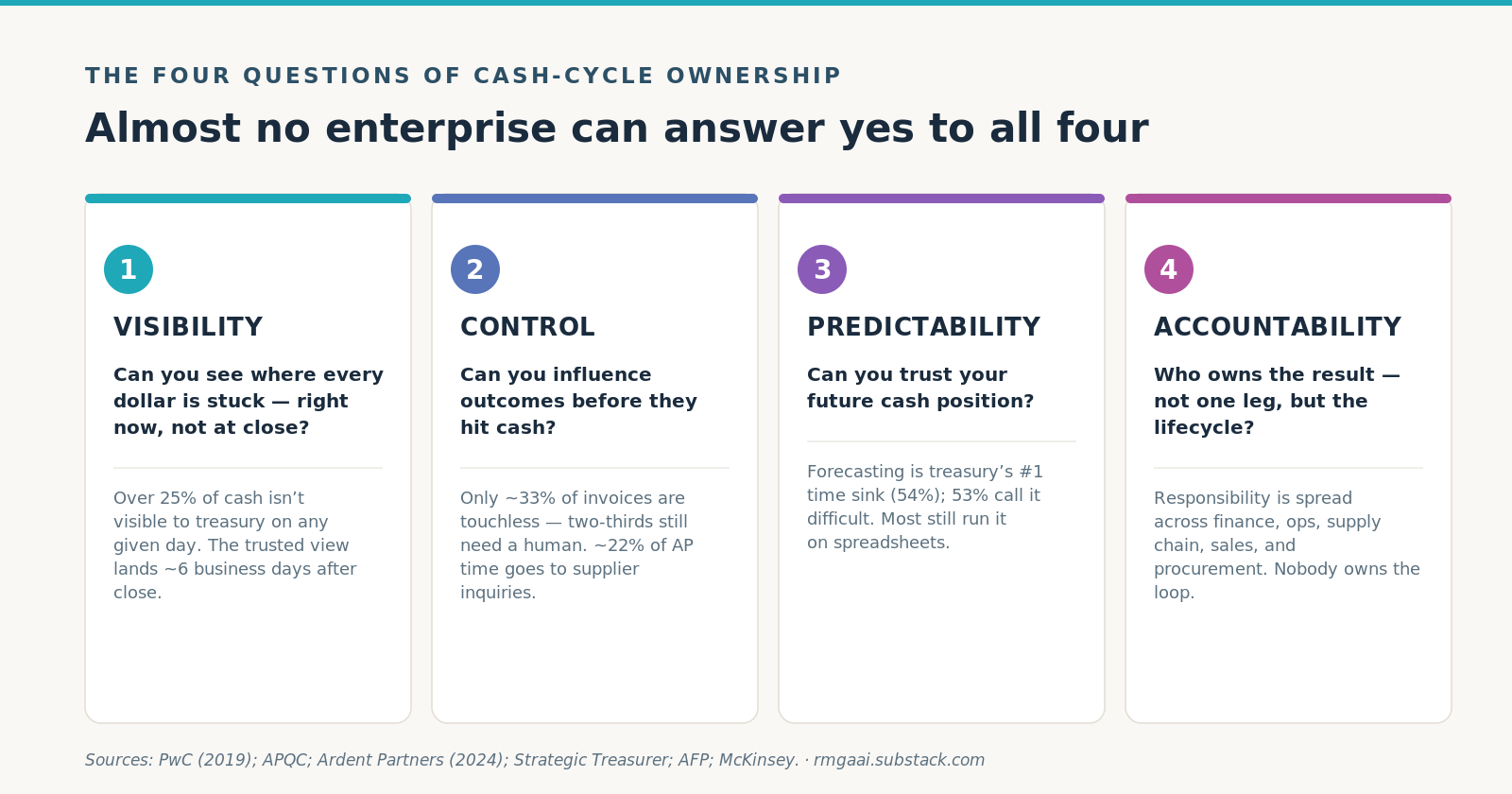
I don’t think this is a technology problem, or a talent problem, or an effort problem. Finance teams are working harder than they ever have. It’s an ownership problem. And the tell is that almost no enterprise can answer yes to four simple questions.
Question 1 — Visibility: Can you see where every dollar is stuck, right now?
Not at close. Now. Where is the cash tied up today, in unbilled work, in disputed invoices, in receivables aging past terms, in vendor obligations coming due, in payment timing?
Most finance leaders can’t say. PwC’s treasury benchmarking found that more than a quarter of global cash isn’t visible to corporate treasury on any given day. And the authoritative view — the one everyone trusts — typically doesn’t arrive until roughly six business days after month-end, according to close-cycle benchmarks from APQC and others. So the number you’re managing to is, on average, a week stale and a quarter incomplete. You are steering a business by looking in the rearview mirror at a photo taken last week.
Visibility isn’t a dashboard. It’s whether the picture is live.
Question 2 — Control: Can you influence the outcome before it hits cash?
Visibility only matters if you can act on it in time. Can you rank collections by who’s actually likely to pay and work them in that order? Enforce payment terms instead of discovering they were missed? Evaluate an early-payment discount while it’s still on the table? Catch the exception the same day it appears, not in next month’s review?
For most teams the honest answer is no, because the day is consumed by triage. Ardent Partners’ benchmarks show only about a third of invoices — 32.6% — process straight through without a human touch, which means roughly two-thirds still land on someone’s desk. AP teams spend close to a quarter of their time (about 22%) just answering supplier inquiries about where an invoice or payment stands. That is not control. That is a team so busy servicing the machine that it can’t steer it.
Question 3 — Predictability: Can you trust your future cash position?
Every CFO gets asked the same question by the board and the CEO: where will cash be in 30, 60, 90 days? And most answer it with a forecast they don’t fully trust, built by hand.
The data backs up the discomfort. Cash forecasting is the single most time-consuming activity in treasury — 54% of teams say they spend more time on it than anything else — and the share who rate it “difficult” has climbed to 53%, up from 39% a few years ago (Strategic Treasurer). AFP finds that 73% of practitioners now rank cash and liquidity forecasting as their top priority. And most of that work still happens in spreadsheets, extrapolating from history rather than reading real payment behavior and real vendor obligations. A forecast built on extrapolation tells you what usually happens. It doesn’t tell you what’s about to.
Question 4 — Accountability: Who owns the result?
Here’s the one that matters most, and the one nobody wants to answer. Not who owns collections, or payments, or the balance but who owns the cycle, end to end, as a single outcome?
In almost every enterprise, the answer is no one. AR owns collections. AP owns payments. Treasury owns cash. Procurement owns spend. Working capital is “cross-functional,” which in practice means four teams each own a fragment and the integration work between them is done by hand, in meetings, over email. McKinsey put it plainly: responsibility for the moving parts of working capital “is spread unevenly across finance, operations, supply chain, marketing and sales, and procurement” — which is why, they argue, it takes CEO-level sponsorship just to get those functions pointed in the same direction.
A cycle that everyone touches and no one owns is a cycle that drifts. It doesn’t fail loudly. It just quietly leaves cash on the table, every single day.
Why this persists — and what actually changes it
None of the four is a problem of will. Every finance team I know would say yes to all four if they could. The reason they can’t isn’t effort; it’s that the four answers live in four different places, and no system holds them at once.
That’s the real shift. Visibility, control, predictability, and accountability don’t require more people or longer hours. They require one live picture of four layers most organizations keep separate: the commitments you’ve made, the obligations you owe, the transactions flowing through the ledger, and the interactions that never make it into the ledger at all — the contracts, the inboxes, the disputes, the “we’ll pay next week” buried in an email thread. The ERP can see the first three. It was never built to see the fourth. And the fourth is where the cycle actually gets decided.
When those four layers are held together and kept current, the four questions stop being aspirational. You can see where cash is stuck because the picture is continuous. You can act because the exceptions surface the day they happen. You can forecast because the forecast is a byproduct of knowing the real state of both legs, not a separate quarterly exercise. And you can finally assign accountability, because there’s now a single view an owner could actually be accountable to.
That is the difference between processing transactions and owning the cash cycle. It is, I’d argue, the finance identity shift of the decade; from a function that reports what happened to one that owns what happens next. The CFOs who make that shift won’t be the ones with the most people or the biggest budgets. They’ll be the ones who stopped waiting for month-end to find out where the cash was.
The cash cycle is going to keep running every business, whether or not anyone owns it. The only question is whether it runs you, or you run it.