

The OCR Era Is Over
What invoice automation actually requires in the age of agentic AI

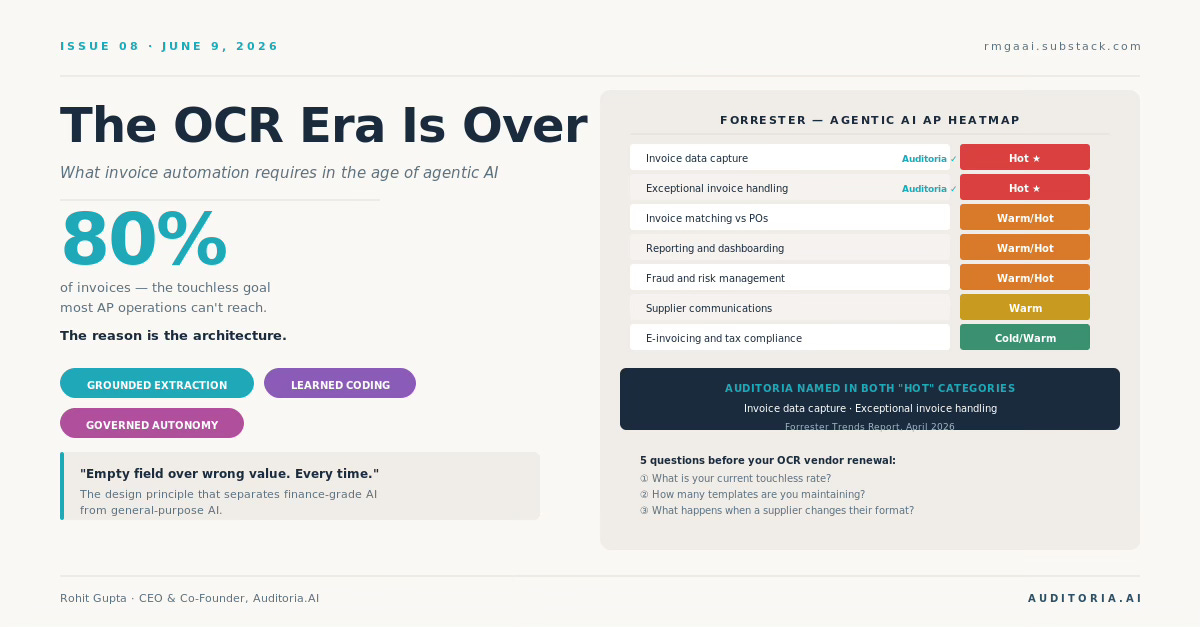
There is a number that every AP director I talk to knows intuitively but rarely says out loud: the percentage of invoices their team processes without a single manual edit. Some call it the touchless rate. Some call it straight-through processing. Whatever you call it, the gap between where most enterprise AP operations sit and where they need to be is the most honest measure of whether your automation investment is working.
The goal that serious AP automation teams are chasing is 80%. Eighty percent of invoices reaching the ERP with zero human intervention — correct fields, correct coding, correct routing, first time. Not 80% of invoices ingested. Not 80% of invoices with some fields pre-populated. Eighty percent fully autonomous, from receipt to posting.
Most operations are nowhere near it. And the reason is not bad data. It is not uncooperative suppliers. It is not change management. It is the architecture of the tools they bought.
What OCR was actually designed for
Template-based OCR was a genuine innovation when it was introduced. The premise was sound: identify the regions of a document where key data appears, extract the characters in those regions, map them to fields in your system. For a finance operation with a stable, predictable supplier base and consistent document formats, it worked.
The problem is that enterprise AP in 2026 looks nothing like the environment OCR was designed for. The average mid-to-large AP operation processes invoices from hundreds of suppliers; each with their own layout, their own field placement, their own formatting conventions, their own language preferences, and their own tolerance for changing that format without notice. Every time a supplier updates their invoice template, a human somewhere has to update a corresponding template in your system. Every new supplier requires a new template to be built before their invoices can be processed autonomously.
This is what Forrester described in their April 2026 trends report on agentic AI in AP: the shift that defines this generation of automation is from extraction systems that rely on “hard-coding templates” to systems that “learn patterns and adapt extraction logic dynamically.” The word “dynamically” is doing a lot of work in that sentence. It means the system improves with every invoice it processes. It means a new supplier format does not require IT involvement to handle. It means the exception that stumped the system last week is handled correctly this week because the model learned from how it was resolved.
Template-based capture cannot do any of those things. It is static by design. And static is expensive — not just in IT labor, but in the exception queues, the cycle time delays, and the supplier inquiries that accumulate when templates fail.
The three things modern invoice intelligence requires
When we think about what it actually takes to reach an 80% touchless rate, three capabilities have to work together. Miss any one of them and the ceiling stays low.
Grounded extraction. The first requirement is that every value an AI extracts must be anchored to its source in the document. This sounds obvious until you understand what ungrounded extraction does: it generates plausible values based on context, which means it will occasionally produce a number that looks right but was never in the document. In AP, a hallucinated value is an overpayment or a compliance failure. Grounded extraction rejects any value it cannot locate and verify in the source document. If it cannot anchor the value, it returns empty — not wrong.
“This design choice returning an empty field over a wrong value is one of the most important principles in AI-based finance automation, and it is almost never discussed publicly. The instinct for any AI system is to maximize the fill rate. But in finance, a confidently wrong answer is worse than no answer. An empty field sends an invoice to the exception queue. A wrong field sends it straight through to an overpayment.”
The willingness to say “I don’t know” and to build that into the architecture is what separates finance-grade AI from general-purpose AI.
Learned coding. The second requirement is that the system learns from your history. Not from a general model trained on other companies’ invoices — from your AP team’s actual decisions, your actual GL codes, your actual business logic, applied to your specific vendor and entity relationships. Predictive coding that learns from historical user edits and ERP write-backs can surface the right coding suggestion before a human ever looks at the invoice. Deterministic rules that encode your business logic as explicit IF→THEN conditions can handle the cases that recur the same way every time, without involving probabilistic inference at all. The combination — learned prediction for novel cases, deterministic rules for known patterns — is materially more accurate than either approach alone.
Governed autonomy at the field level. The third requirement is the one most vendors either skip or handle poorly: the ability to expand automation incrementally, one field and one supplier at a time, with trust earned at each step before the scope expands.
The design principle that makes this work and that we have built into every layer of our AP Invoices product is asymmetric authority. An AI agent can switch its own autonomy level down. It can flag its own uncertainty, route itself to review, and reduce its own confidence threshold when it detects patterns outside its training. What it cannot do is unilaterally switch autonomy up. That decision always requires a human. The system fails safe.
This is not just a UX choice. It is an architectural commitment to the principle that trust between an AI system and an enterprise finance team has to be earned incrementally, not assumed by default. The progression looks like this: the agent observes, surfaces its recommendations for human review, and earns approval on each decision type before it is permitted to act on that type autonomously. Scope expands as accuracy is validated. Autonomy is not a binary switch — it is a graduated expansion with a human always holding the governor.
What Forrester’s heatmap tells you
In April 2026, Forrester published their trends report on agentic AI in AP. Two use case categories came back rated “Hot” the highest adoption rating in their framework: invoice data capture and exceptional invoice handling. Both represent areas where agentic AI has moved past experimentation and into production, delivering measurable ROI.
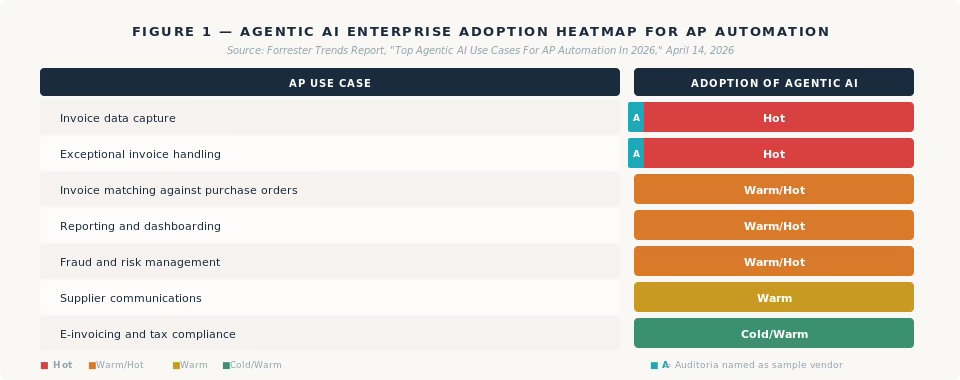
Auditoria was named as a sample vendor in both categories, alongside the incumbent template-based capture vendors. The fact that we appear in the same Forrester tables as the platforms that have dominated this space for a decade tells you something about where the category is heading. The question is not whether agentic AI replaces template-based OCR it does, structurally, over time. The question is whether you capture that transition on your terms or get caught managing the replacement reactively.
The market data is equally clear: the invoice automation software market is growing at 14% annually through 2032. That growth is not being driven by companies buying more template-based OCR. It is being driven by organizations that are dissatisfied with their current touchless rates and are investing in a fundamentally different approach.
Five questions before your next OCR vendor renewal
If you are on a contract with a template-based capture vendor and that contract is coming up for review, here are the five questions that will tell you whether the investment is working:
1. What is your current touchless rate? If you do not know this number, find it before you renew. The percentage of invoices that reach the ERP with zero manual edits is the only metric that directly measures the ROI of your AP automation investment.
2. How many templates are you currently maintaining? Every template has a creation cost, a maintenance cost, and a failure cost. If you cannot tell your vendor how many templates your team manages and what they cost annually to maintain, you are not accounting for the full cost of the system.
3. What happens when a supplier changes their invoice format? The answer to this question separates template-based systems from learning-based systems in the most practical way. If the answer involves IT tickets, template rebuilds, or a manual processing period, you are paying a tax on every supplier format change that occurs.
4. Can your system expand automation field by field, vendor by vendor? Full-autonomy-or-nothing is a trust problem masquerading as a product feature. The ability to enable automation on one field for one vendor while keeping another field in review is what allows AP teams to earn trust incrementally rather than taking an all-or-nothing bet.
5. What does the audit trail look like for every autonomous decision? Your controller needs to be able to review any AI-made coding decision without calling IT. If the system cannot produce a human-readable trace of why a field was coded a particular way, it is not suitable for enterprise finance operations.
Where this is heading
The direction of travel in AP automation is not ambiguous. Forrester sees it. The market data confirms it. The enterprises that have already moved away from template-based capture to agentic AI extraction are reporting what you would expect: lower exception rates, shorter cycle times, fewer manual touches per invoice, and a touchless rate that improves with every processing cycle rather than degrading as supplier formats drift.
The 80% touchless rate is not a theoretical target. It is an engineering goal we are actively working toward, with a clear view of the three initiatives — grounded extraction, learned coding, and graduated autonomy — that make it achievable. We are not there yet at scale. But the architecture that gets there is well understood, and it is not template-based.
If you are an AP Leader or Controller staring at your current touchless rate and wondering whether the next renewal is the right moment to make a different choice, I am happy to have that conversation. Reply here, or reach me at rohit@auditoria.ai.
Rohit