

Why "Agentic-Native" Just Won the Leader Quadrant
CB Insights named Auditoria a Leader in Finance & Accounting AI Agents. Here's what the map is really telling you about where the Office of the CFO is headed.

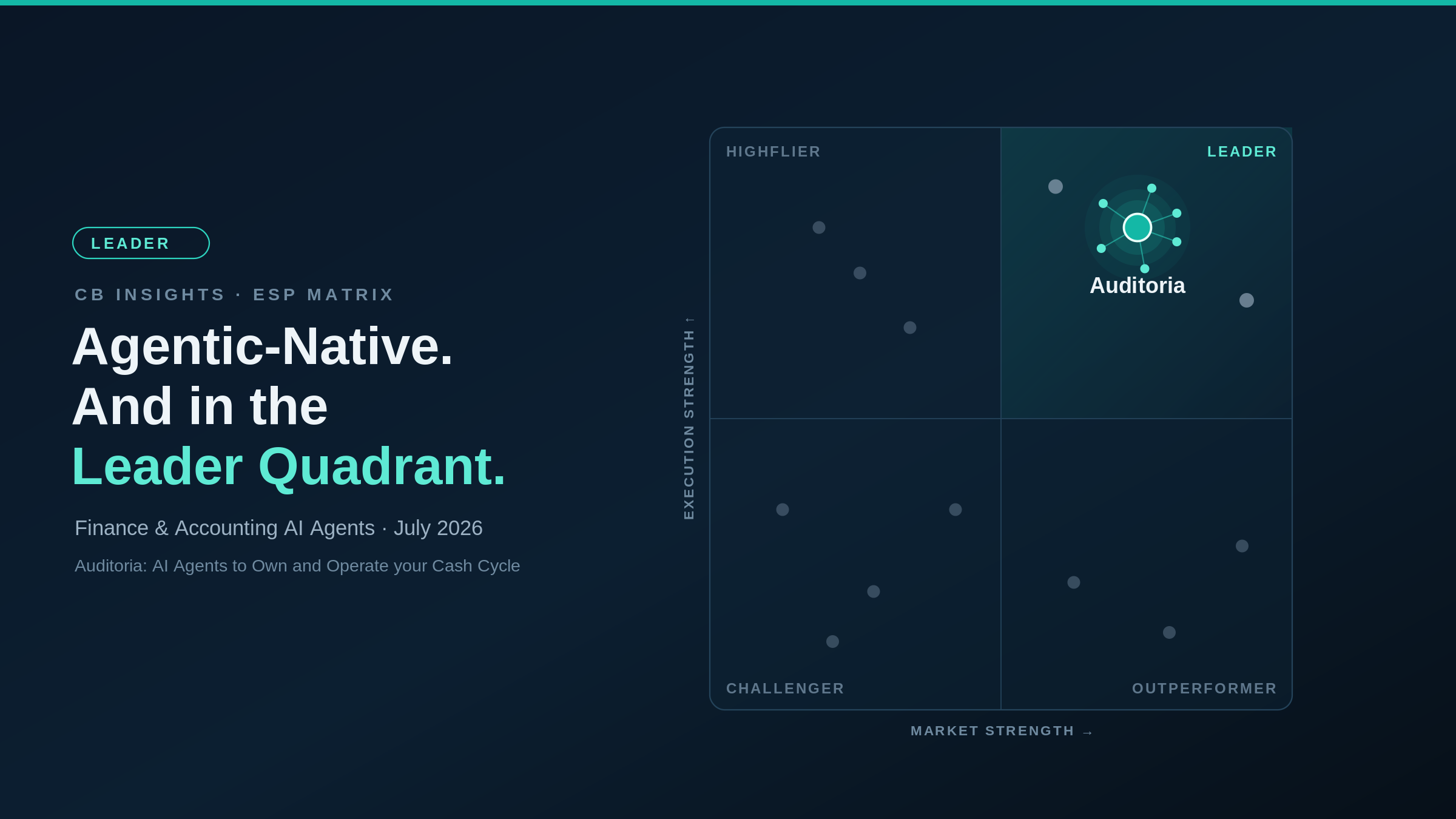
CB Insights published its latest ESP Matrix for Finance & Accounting AI Agents this month; the analyst framework that ranks vendors on two axes, Execution Strength and Market Strength and there are exactly three companies in the Leader quadrant: FloQast, Sage, and Auditoria.
I want to talk about that quadrant, not because we’re in it, though I’m proud we are, but because of what its shape says about this market. Analyst maps are easy to treat as trophies. This one is more useful as a diagnosis.
How to read the map
The matrix plots vendors on those two axes. Market Strength runs along the bottom; momentum, funding, partnerships, mindshare. Execution Strength runs up the side detailing the depth, breadth, and maturity of what the product actually does. The upper-right corner, where both are high, is Leader.
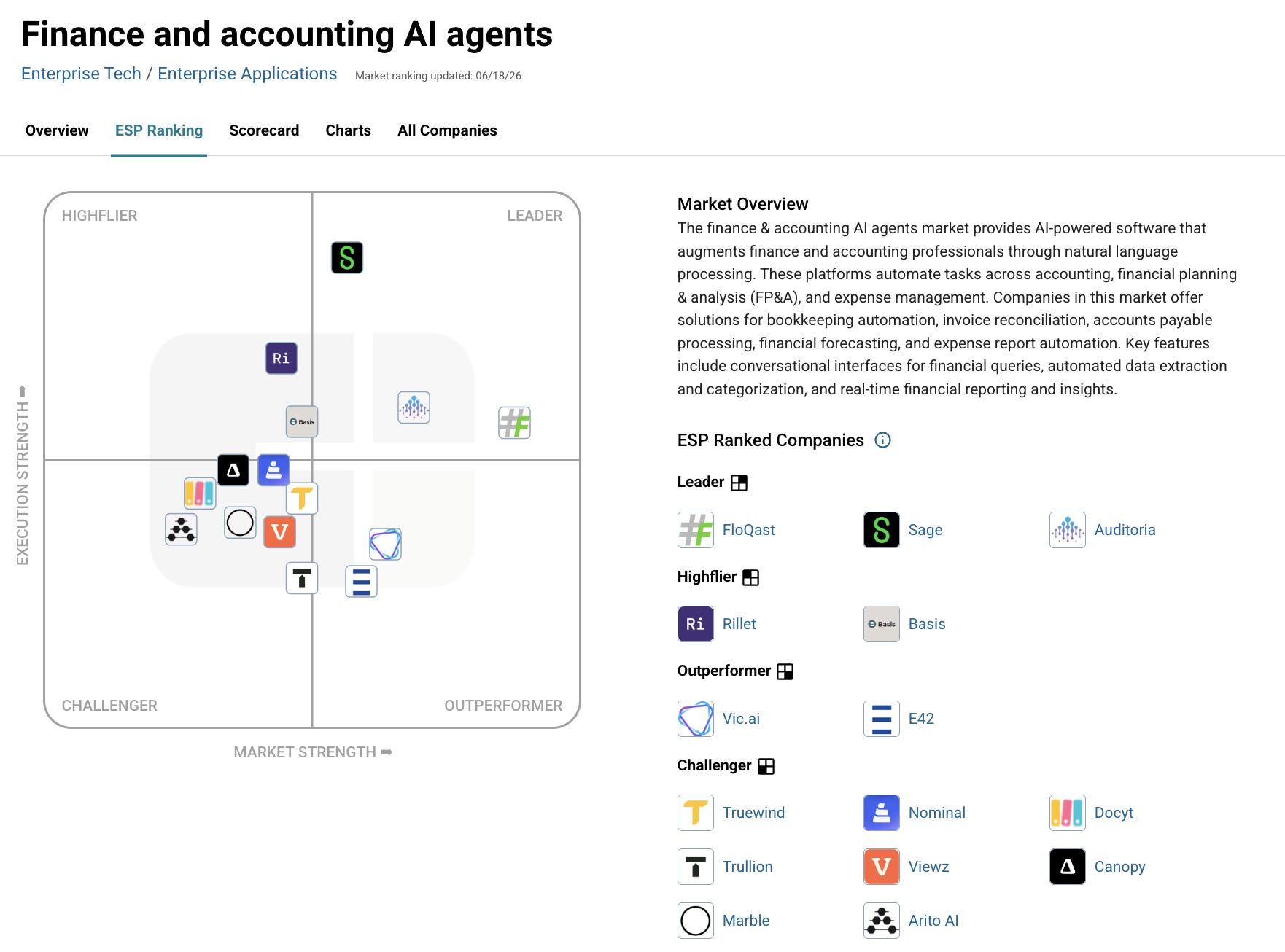
Two of the three Leaders got a strong pull to the right from sheer market gravity. Sage is a multi-billion-dollar ERP with decades of install base. FloQast owns a beachhead, namely, the accounting close and has built serious brand equity there. Both earned their spots.
Auditoria is the youngest company on that board, without an ERP’s install base behind it. We’re in the Leader quadrant because of the vertical axis: Execution Strength. That’s the one you can’t buy with a balance sheet or a decade of head start. It reflects what the agents do, how much of the finance function they cover, and how autonomously they operate.
That’s the distinction I’d ask any finance leader to sit with. Market Strength tells you who’s big. Execution Strength tells you who’s built the thing that actually works.
The pattern in the lower quadrants
Now look below the Leader line. The Highflier, Outperformer, and Challenger tiers are full of genuinely good companies. Study what most of them have in common and you find the real story of this market: they’re excellent at one thing.
One tool nails accounts payable. Another does reconciliation. Another wraps a conversational copilot around your reports so you can ask questions in plain English. Each is a legitimate product. But each is a slice.
This is the natural first shape of any AI wave. The earliest useful applications are narrow, because narrow is tractable — a single workflow, a single data source, a clear before-and-after. The market fills up with point solutions and copilots. It’s real value, and it’s also a ceiling.
Because the Office of the CFO does not have an accounts-payable problem, or a reconciliation problem, or a reporting problem. It has a cash cycle ownership issue with money moving in and out, obligations landing, forecasts shifting, exceptions piling up, all at once and all connected. A tool that automates one lane leaves the controller stitching the lanes together by hand. Ten point tools don’t add up to an autonomous finance function. They add up to ten more integrations to own.
What “agentic-native” actually means
The word “agent” is doing a lot of work in this market right now, and most of it is marketing. A copilot that retrieves an answer is not an agent. An agent takes an objective, breaks it into steps, does the work across systems, handles the exceptions, and knows when to escalate to a human.
Auditoria was architected for that from the start, and it’s the reason we cleared the Execution Strength bar. Two layers matter:
The AI data platform underneath. Finance agents are only as good as their grasp of finance data — vendors, invoices, terms, ledgers, entities, the messy reality of how a real company’s books actually look. We built a purpose-built data layer for exactly this, so the agents reason over finance the way a seasoned analyst does, not the way a generic LLM guesses.
The Agentic orchestration layer on top. Arrow from Auditoria is what turns individual agents into a coordinated team. It runs autonomous agents across accounts payable, accounts receivable, general ledger, and FP&A; coordinating the handoffs, so the AP agent’s work informs the cash forecast, and an AR exception doesn’t fall through a crack between two disconnected tools. Orchestration is the hard, unglamorous part. It’s also the part that separates “a chatbot for finance” from “an autonomous finance function.”
CB Insights defines a Leader as a vendor with “the breadth to address various customer needs.” Read that again with the map in mind. Breadth is the Leader criterion and breadth, done well, is precisely what agentic orchestration delivers and what a point solution, by definition, cannot.
Where this goes next
If the first phase of AI in finance was copilots and single-workflow automation, the next phase is orchestration: agents that don’t just assist the finance team but operate as part of it, end to end across the cash cycle. The ESP is an early snapshot of that shift. The companies pinned to a single lane are, whether they intend to or not, betting the market stays narrow. The Leaders are betting it goes broad and autonomous.
We’ve been making that second bet since before it was obvious. The recognition is nice and it stacks on a strong year, including Best FinTech Solution for AP/AR, the Forrester Agentic AP MarketGuide, the Gartner Hype Cycle for Autonomous Accounting and the CB Insights Fintech 100. But the reason to write this isn’t the badge. It’s that the map now says, in a third party’s data, what we’ve been telling the Office of the CFO all along: the future of finance isn’t a better copilot. It’s a team of agents that owns the cash cycle.
We’re just getting started.